Supercar Engineering Debunked
The 3 basic technologies behind what makes a modern supercar great - Clever aerodynamics, superior grip and instant power.
Sometimes it is good to step back and understand the basics of what makes a modern supercar perform in the way it does. What are the fundamentals of supercar engineering and how are they being leveraged to make your supercar excellent?
Our supercars are not just fast because they have the biggest engines or the best specification tyres, they’re fast because their entire DNA is built around clever engineering that is constantly adjusting and manipulating how the car drives and behaves. In essence, there are 3 main technologies that influence this and the better the car designers can get these working in harmony, the better the car will perform.
Active Aerodynamics
Firstly, let's look at the aerodynamics. Supercars look the way they do for a reason. It is not just to look cool (although this a big part of why we fall in love with certain shapes), it is to conquer the air they’re travelling through and use this to their advantage.
Supercars are the masters at letting the car manipulate the air around them, and to achieve this, they employ a myriad of aerodynamic tricks. Traditionally, when cars were first beginning to be used for sport, the shape and the aerodynamics were fixed. Compromises therefore had to be made to straight line speed to accommodate better cornering and vice versa. Racing teams began to exploit the air to produce downforce by using additional bodywork elements such as rear and front wings, diffusers and adjusting elements, like lowering the ride heights and weight distribution. The use of all of these tricks were adjusted pre-race to try and find the best balance in an attempt to offer as much downforce as possible through the corners without damaging the overall drag and top speed in a straight line.
Once the technology was developed to allow cars to move these elements, then cars began to adapt as they travelled. Now cars have flaps, wings, rear spoilers and vents which all adjust in real time giving you the best cornering ride while keeping the speed. When you want high speed, all these elements work together to flatten out, or direct the air making the airflow much more efficient. When you brake for the corners however, they all come to life by tilting or moving, forcing the car into the road, producing grip in the right places when you need it.
Modern supercars can now even move the air through the car through channels within the bodywork to increase downforce even further. These can even adjust to activate on just one side of the car, providing grip to the side which needs it most.
The result of all the new developments in aerodynamics in the last 50 years has seen a generation of supercars with astonishing top speeds, but still have the stability that enable them to be used on roads as well as racing circuits.
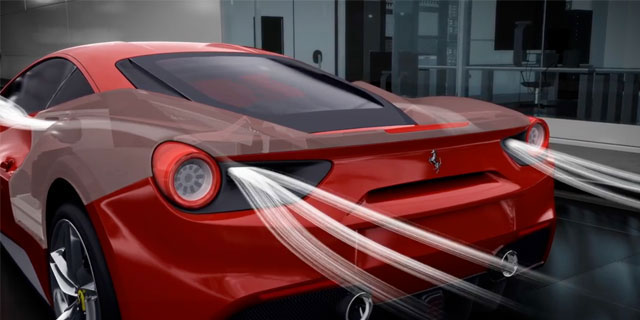
Active aerodynamics in the Ferrari 488 ©Ferrari
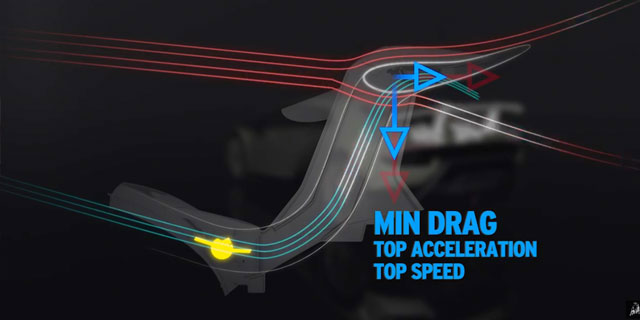
How the Lamborghini Active Aerodynamics (ALA) works
Torque Vectoring
In a nutshell, torque vectoring is the science of how your car interacts with the road. In a normal road car, the power is transferred from the engine to the axle and that power is evenly split between the two wheels. In short, both wheels receive the same power, irrespective of the grip they’re experiencing, or require. Given that most family cars are not pushing too hard through the corners, this is perfectly adequate.
In a supercar, the need for grip becomes slightly more pressing when dealing with the speeds and the power at your disposal. The idea is to make this power work smarter and deliberately send more to the wheel that needs it, usually the outside wheel in a corner as this is the one that has more load and therefore more grip.
This is achieved in a couple of ways. Firstly with an intelligent brake based system which lightly brakes the inside wheel in order to direct the available torque and secondly, an electronic system that uses telemetry data to actively distribute the power.
With the power in the correct places, the supercar will feel more agile giving the driver the confidence to really attack the corners knowing the grip will be there. The better electronic systems will help to eliminate understeer and ensure the maximum speed.
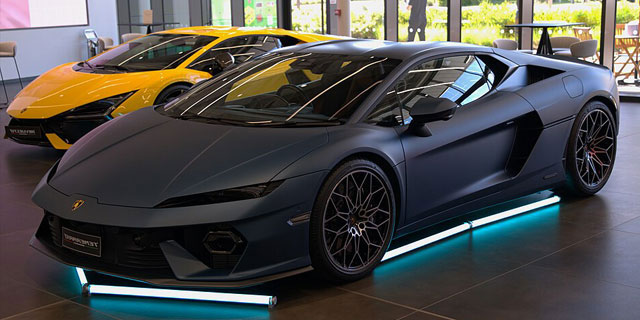
The Lamborghini Temerario uses all these technologies. ©Wikipedia
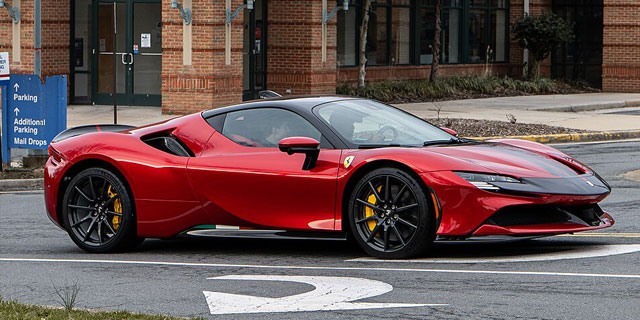
Ferrari SF90 showing the front wing working ©Wikipedia
New Hybrid Systems
The word ‘hybrid’ and supercars have a troubling relationship. Most see a hybrid system as a compromise, looking to save fuel and help save the planet. Actually it just simply means there is more than one power source.
Traditional petrolheads often rail against the oncoming inevitability of a move away from traditional fuels in favour of electric motors, and see it as just another attack on fun seeing the demise of the supercar and the V12 engine.
Almost all major supercar marquees now have a top line hybrid model which combines, often a highly tuned V8 with two, or sometimes four electric motors.
This gives these new supercars a few advantages over their predecessors.
Instant Results
Traditional supercars would enhance their performance with injectors, turbos and other mechanical tricks to boost power. As these were all mechanical working parts of an engine, there was always a slight, but noticeable delay in being able to push the car faster. With electric motors, this transfer of power is instantaneous. The result is a way of accelerating that supercar engineers 20 years ago could only dream of.
Power Boosting
The electrical systems help to magnify the existing petrol engines, adding significantly more horsepower to an already eye watering power unit. We now see supercars producing in excess of 1000 bhp without breaking a sweat, giving the modern supercar driver all the power they are ever going to need without the need for huge V12 engines.
You are in Total Control
Electric motors can be controlled far more accurately than traditional combustion engines. Using computers and Ai these can make fine adjustments in nano seconds, without the driver even realising. They make you a better driver by taking a lot of the guess work out of high speed cornering. They can of course be turned off and on depending on the required experience or the general experience of the driver. What is important is you are in complete control and can tailor your drive each time you take the car out. Sometimes in inclement weather, you might prefer a clever assistant who helps keep things neat and tidy and then, when you’re feeling up for it, you have a bit of fun keeping the car in check.
With the really clever systems, you don’t feel the transition between electric and petrol power at all. You just feel superb acceleration and enjoy an effortless drive.
Another criticism of hybrid systems is that they add extra weight making the modern supercar ungainly and awkward. This is only partially true as electric motors used in the hybrid systems don’t require the massive batteries seen in a fully electric car. They only need to deliver intense bursts of energy for acceleration, leaving the V8 to handle the long distances. It is true they do add a level of complexity and some extra weight, but they are very much still in their infancy and will only get better and lighter.
With these three major new technologies working together, we see supercars with excellent downforce, grip and power giving the ordinary supercar owner and machine they can have some real fun with.
Where does this leave the old V12 supercar? This is still an ongoing debate within the supercar community. These driver aids and assistance is not for everyone, so there is still an active market and manufacturers willing to produce stripped down supercars for those still wanting that raw experience.
Now Ai is an integral part of supercar design and within the car itself, this seems most likely to be the main driver on how supercars develop in the medium term. Allowing clever technology to control and enhance power and grip will be a game changer within the supercar sector.